
When the lighthouse got its own power station
When Kullen Lighthouse was electrified in 1937, the yellow brick building next to the tower was built. It housed the lighthouse’s own power station: two 50 hp Bolinder crude oil engines with direct-coupled generators and a large storage battery. The engines ran during the day to charge the battery, which then powered the light through the night. The new 1,000-watt lamp made Kullen the brightest lighthouse in Scandinavia.
The building work caused protests. Part of the lighthouse’s original gneiss building was demolished to make room for the extension, despite objections from both the lighthouse staff and local people. Several of the workers in 1937 were in fact the same men who had built the lighthouse in 1900.
From power station to backup
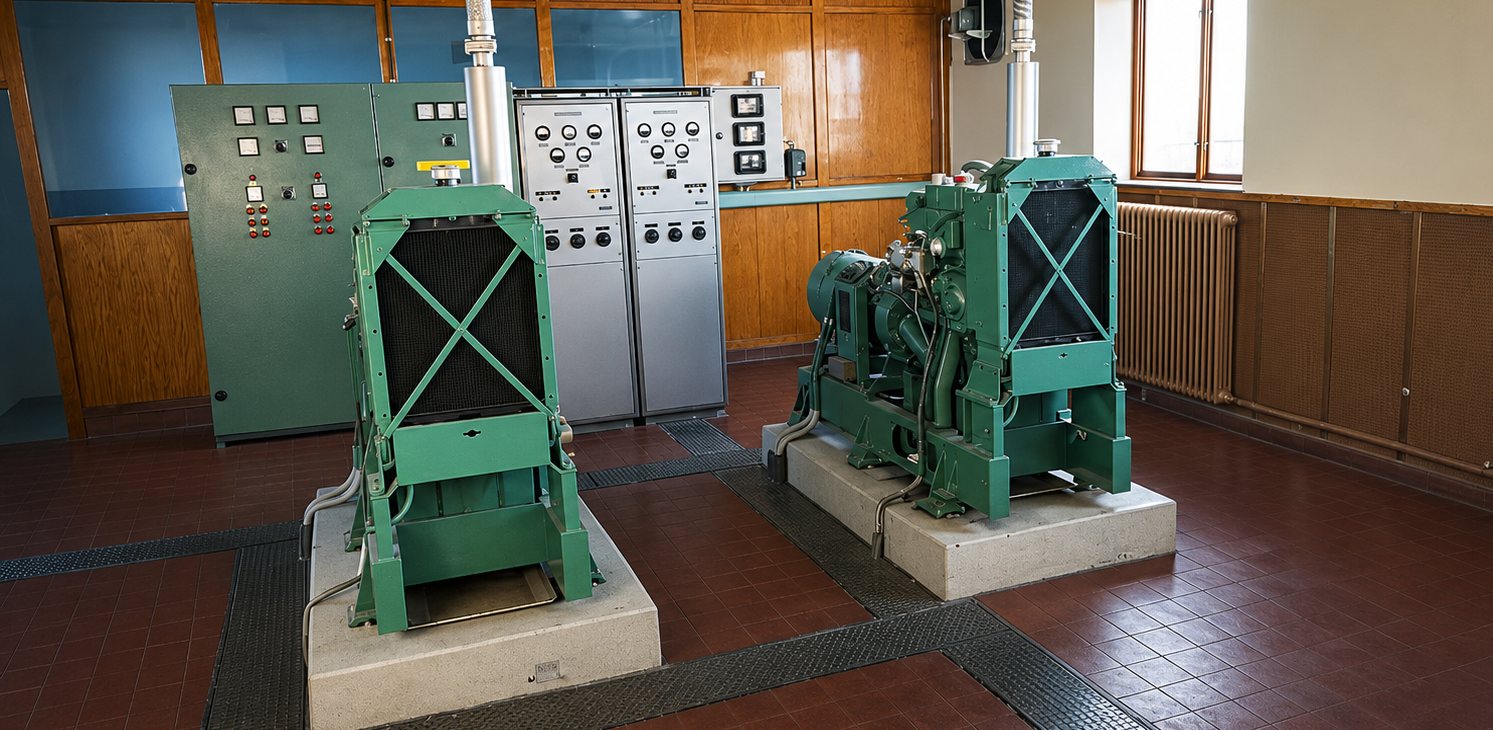
In 1946 a power cable was laid up from Mölle and the lighthouse was connected to the grid. The battery and one of the generator sets were moved, and the other became the backup in case of power cuts. In 1963 the old engines were replaced by the two Bolinder-Munktell diesels that stand in the engine room today, the same type of engine as in the classic BM 350 Boxer tractor.
A clockwork and a bit of a lottery
The starting system had no computers at all. When the power went, a clockwork started ticking, and rotating discs with a built-in code decided which of the two engines would start, a bit like a lottery. The engines were built for six weeks of continuous running and were meant to take turns.
When the technicians from the Swedish Maritime Administration test-ran them, it was quite an experience. A deafening alarm went off, the whole building rumbled and shook, and the exhaust stood out of the window like a blue-grey broom. The adults were happy to take a step back, while the children covered their ears with shining eyes.
The final start
In just over 50 years the engines ran for barely 400 hours each. On 7 September 2015 they were started one last time before being disconnected for good. In the age of GPS, the light is considered able to manage without backup power. The lighthouse’s DGPS station, which makes GPS more accurate, still needs power around the clock, however. Today it is secured by 20 batteries that can run the station for a day.
The engines are still in the engine room, and you can see them when you visit the lighthouse.
Backup power in figures
| Engines | 2 Bolinder-Munktell, model 1113 |
|---|---|
| Type | 3-cylinder four-stroke diesel with direct injection |
| Output | 56 hp DIN at 1,800 rpm |
| Displacement | 3.78 litres |
| Bore × stroke | 111.1 × 130 mm |
| Oil capacity | 10.5 litres |
| Generators | 2 × 35 kVA |
| Fuel consumption | about 1.5 litres/hour at the lighthouse’s load, 5–10 litres/hour at full load |
| Designed for | 6 weeks of continuous running, then switching between the engines |
| Lighthouse load | 1,000 W lamp + lens motor of a few hundred watts |
| Running hours | 388 and just over 400 hours respectively |
| Installed | 1963 (the engines were probably made in 1961/62) |
| Last run | 7 September 2015 |
| Replaced by | 20 × 24 V nickel-cadmium batteries, 555 Ah, for the DGPS station |