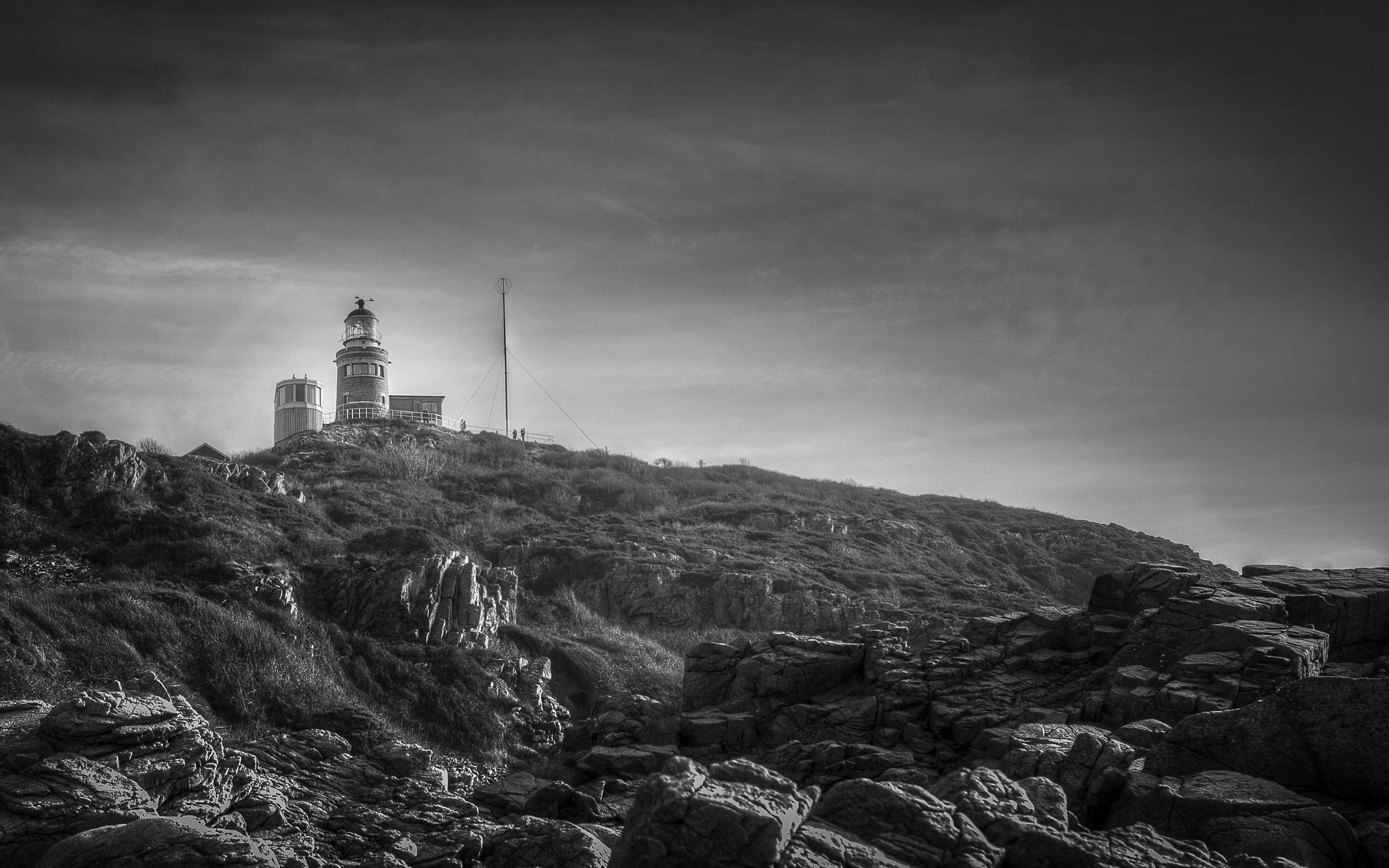
At the tip of Kullaberg stands the most powerful and highest lighthouse in Scandinavia, on one of the world's busiest waterways, the Øresund. It is the oldest light station in Scandinavia, established as early as 1561.
- Position
- 56° 18’ 6’’ N, 12° 27’ 11’’ E
- Height above sea level
- 78.5 metres – Sweden's highest lighthouse
- Range
- 27.5 nautical miles (approx. 50 km)
- Luminous intensity
- 3.8 million Hefner candles – the most powerful in Scandinavia
- Optics
- Three rotating 1st-order Fresnel lenses by Barbier & Bernard, 2.55 m in diameter, approx. 6 tonnes, four rotations per minute
- Tower
- 15 metres high, gneiss from Ablahamn and brick, built in 1900 (the 6th tower on the site)
- Swedish light number
- 714900
- International light number
- C2262
- Light characteristic
- Oc(3) WG 20s
- Owner/manager
- Swedish Maritime Administration
A brief history
In 1560 King Frederick II of Denmark ordered “fire pans” to be set up at Skagen, Anholt and Kullen. The one at Kullen was probably ready on 1 March 1561. It was a so-called “papegoie” (parrot) that could be lowered, refilled and lit – the light came from a wood fire in an iron basket, hanging from a frame of heavy oak timber 20 ells high. Kullen’s first lighthouse master was Marcus Hesz.
As early as 1563 the “parrot light” was replaced by a masonry stone tower with a lead roof and twelve large tallow candles. In 1585 a new masonry tower was built on the spot where the lighthouse stands today.
In the early 1600s people began burning coal in the open – it did not go out as easily in the rain, burned longer and gave a clearer flame. In 1624 Kullen Lighthouse was rebuilt as such an open coal fire. It used 6–7 hectolitres of coal every night, mined at Tinkarp and carried up by the farmers of the so-called lyktehemman, the farms obliged to supply the light, and later by the fishing community – a heavy burden. Coal mining began in Höganäs in 1641, and later coal was also brought from Scotland, which gave a stronger light.
In the summer of 1749 the old, dilapidated tower was pulled down and a new lighthouse built – at the time the most modern and reliable in Scandinavia. Complaints about how it was kept continued, however, and in 1783 Anders Polheimer was commissioned to improve the light. In 1792 the lighthouse was rebuilt to his design, with wind tunnels that drove oxygen up through the tower.
The construction through the years
| 1817 | The lighthouse was rebuilt with a lantern. The coal fire was enclosed in a “glass house” and burned with a steadier flame – a method developed in Denmark by Löwenörn. Coal consumption and the burden on the farmers who supplied the light fell dramatically. The same year a lever light was put up at Kullen as a reserve during the rebuilding. Polheimer’s lighthouse remained in use until 1843, when the coal era came to an end. The lighthouse became a “rotating reflector light” with twelve rapeseed oil lamps and twelve parabolic brass reflectors. |
| 1857 | The reflectors were silver-plated to improve their performance. |
| 1882 | The rapeseed oil was replaced by 12 single-wick paraffin lamps. |
| 1898 | Kullen West (Kullens västra) was built as an auxiliary light, with a 4th-order lens (500 mm) and a single-wick paraffin lamp. Since 2013 its light source has been LEDs made by Sabik, model LED-155. |
| 1899 | Work began on the 6th tower, built of Kullaberg’s reddish-grey gneiss from Ablahamn, with a 1st-order lens (1840 mm). The lighthouse was built by a specialist team from Skepplanda, travelling lighthouse builders who worked on 30 lighthouses all over Sweden. |
| 1906 | The paraffin lamps were replaced by a Lux lamp with three incandescent mantles of 45 mm each. The luminous intensity rose to 500,000 Hefner candles. |
| 1937 | The lighthouse was electrified, with its own power plant and engine room. |
| 1974 | Kullen West was replaced by a 3.5 m high, maintenance-free plastic light made in Klippan. |
| 1979 | The lighthouse was automated. |
| 2015 | The engines were retired in October, as the power supply was considered stable. 20 series-connected Ni/Ca batteries (24 V) secure the DGPS operation, with enough capacity to run the station for 24 hours. |
| 2016 | The 600 kg mercury bath that had served as the lens bearing was replaced by two oil-filled bearings carrying the lens assembly, which weighs almost 6,000 kg. |
Automated and electric
The lighthouse was automated in 1979. Today the light source consists of 2 × 1000 W/120 V halogen lamps that switch on and off automatically at dusk and dawn. The lens must keep rotating during the day as well – otherwise the powerful lens could act as a burning glass and destroy the lamp. The 1937 extension houses the electrical equipment and two diesel generators for backup power during outages. The light still serves as an aid to navigation, especially for leisure boats – for larger ships, the lighthouse’s DGPS station continuously transmits precise position signals.