
Lighthouse story
Sailors' baptism at Kullen
“Att hönsa för Kullen” – paying tribute to Kullen
Most people have probably heard of the sailors' baptism: an initiation rite for seafarers crossing the equator for the first time. Less well known is that in times past the tradition was also observed when passing Kullaberg. This ancient seafaring custom was called “att hönsa för Kullen”.
It meant that you either had to pay a fee or were baptised, that is, dunked in the sea, when you passed Kullen for the first time. While it was a kind of hazing, it was also a mark of respect for this special place. Perhaps it was also a relic of pagan sacrificial thinking: you made an offering to ensure a safe passage past a dangerous place.
The four dreaded places for sailors' baptism in 1661
According to a doctoral thesis from Uppsala, it was the seafaring Dutch who began the rite. On one of the world's oldest ocean charts, Joannes van Loon in 1661 marked four places on earth where sailors' baptisms took place. Notoriously feared places were chosen for the initiation, and we were as surprised as we were excited when we discovered that Kullen was one of these unique places:
- North Cape (the gateway to the White Sea)
- Kullen (the gateway to the Baltic)
- Pointe du Raz in Brittany
- Berlengas (also known as the Emperor and the Empress) off the west coast of Portugal
The Portuguese are then said to have picked up the tradition from the Dutch and extended it to the equator. According to the thesis, it is thus likely that sailors' baptisms took place at Kullen before they were practised at the equator!
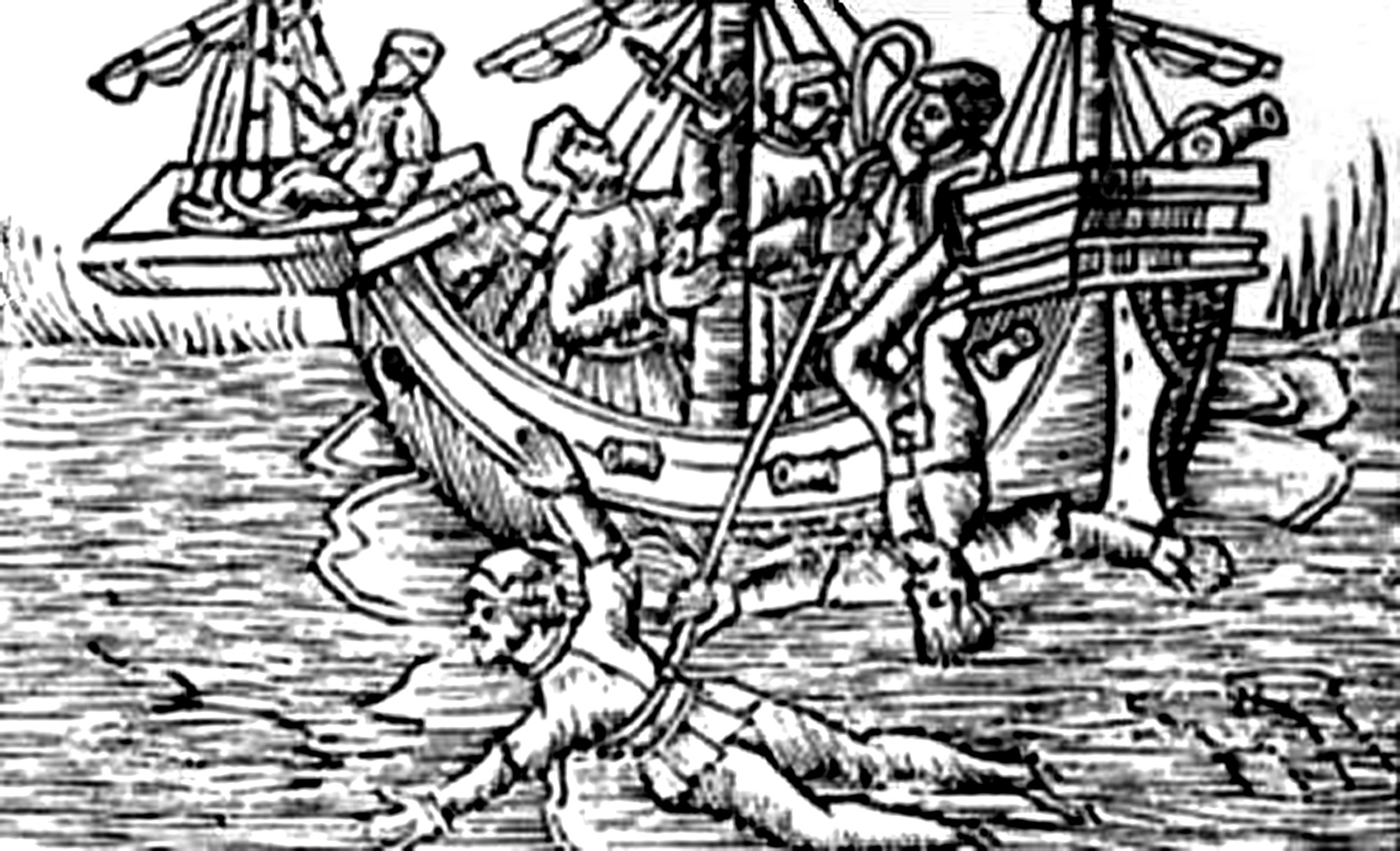
The first documented case of a sailors' baptism at Kullen dates from 1612. That year the Frenchman Anthoni de Lybrey wrote an indignant letter of complaint to the mayor of Helsingør, after having been thrown into the sea three times from the mainmast with only a rope under his arms. He got no sympathy, however: the custom was said to have been practised at Kullen since time immemorial. Several other cases are reported from the 1600s. Even the king of Denmark is said to have had to submit to the baptism off Kullen. So no one escaped.
A deadly but long-lived tradition
The custom may seem light-hearted, but a 15 m drop with only a hemp rope under the arms into ice-cold water or heavy seas sounds risky, to say the least. Especially since few people could swim until well into the 1900s, even among sailors.
The ritual off Kullaberg also had to take place at a specific spot at sea: “… and the Dutchman says, when he comes abreast of Kullen where the mountain seems roundest: Vor dem rund, water in mund”. One can imagine the anguish of the young sailors of the 1600s.
Drownings occurred, and the authorities did all they could to curb the baptisms. The maritime law of 1667 actually devotes an entire chapter to the baptisms at Kullen, but the custom was deeply rooted. Despite severe penalties it lived on for another 300 years or so. As late as 1882 there is evidence of the tradition on a Dutch ship passing Kullen. The Kullen baptism survived longest among Finnish, Latvian and Estonian ships. There are memories from as late as the 1930s, when old seafarers told of the baptisms off Kullen.